The Camera You Brought
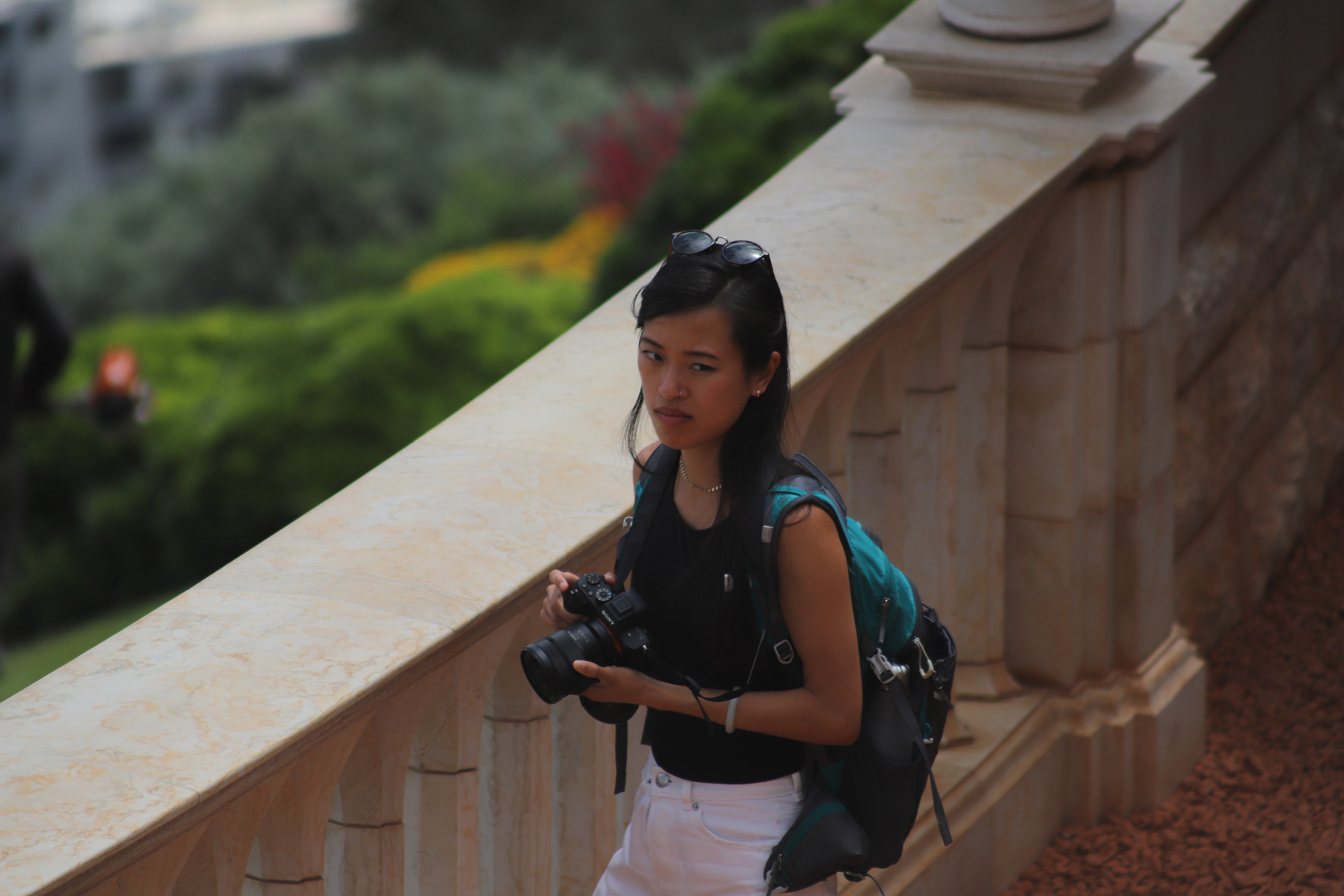
There’s a version of travel photography that involves light stands, permits, pre-dawn location scouting, and a pelican case full of glass. That’s not what this is. What this is — a woman moving along the marble terraces of the Bahá’í Gardens in Haifa, Sony mirrorless raised, backpack on, sunglasses pushed up into her hair because she forgot to take them off — is the other kind. The kind most people actually do. The kind that produces, against all odds, most of the photographs worth looking at.
Casual travel photography gets dismissed a lot. Gear forums are full of the dismissal. Wrong lens, wrong body, wrong hour of light, wrong approach to the histogram. The criticism usually comes from people who are very serious about photography and not very good at travel, in the sense of being present somewhere unfamiliar and responding to it honestly. The camera they’d recommend you bring would require you to think about the camera more than the place. That’s a trade-off that sounds like an upgrade and isn’t.
The Sony she’s carrying — it looks like an A7 series body, though the exact generation is hard to pin from this angle — is a real camera. Not a compromise, not a point-and-shoot dressed up in mirrorless clothing. She’s got a decent zoom on it, she’s holding it properly, she knows what she’s doing. But she’s also wearing a backpack and white jeans and she’s clearly just walking around, which means her photography is embedded in her experience of the place rather than the other way around. That distinction matters more than any spec sheet.
The best travel photographs are almost always made by people who would have been there anyway. The location wasn’t scouted for the light; the light was just there, and someone noticed. The frame wasn’t composed against a tripod; it was found in the gap between one step and the next. This isn’t an argument against preparation — knowing your camera, knowing roughly what you want, having enough battery — but it is an argument against the kind of preparation that turns a trip into a production. Productions produce production photographs. Clean, controlled, technically accomplished images of places that look exactly like the brochure, made by someone who was so focused on making the image that they weren’t quite in the place at all.
The Bahá’í Gardens are, photographically, almost too easy. The geometry is overwhelming: eighteen terraces descending from the Shrine of the Báb on Mount Carmel to the German Colony below, pale limestone balustrades, obsessively manicured cypress and rose and lawn, the blue of Haifa Bay in the middle distance. Every composition you try works. That’s actually a trap, in the same way that a very beautiful face is a trap for a portrait photographer — the subject does so much of the work that you stop thinking about what you’re doing, and the results are technically fine and emotionally inert. Everyone who visits comes away with the same photographs: the long diagonal of the terraces from the top, the fountain, the shrine. They’re beautiful images. They’re also completely interchangeable.
The photograph that doesn’t look like everyone else’s photograph from the Bahá’í Gardens is the one of a photographer making photographs. Someone in the act of looking, caught from behind or the side, framed against that same limestone railing — it reintroduces the human scale that the architecture tends to swallow. You stop seeing a monument and start seeing a person in a place, which is, when you strip everything else away, what travel photography is supposed to be for.
There’s something specific about the posture in this image that’s worth noting. She’s not posed. She’s not performing being a photographer for someone else’s camera. She’s leaning slightly forward, weight shifted, attention already somewhere past the frame she’s about to make. That’s the posture of genuine concentration, and it reads completely differently from the staged version — the influencer-with-camera shot, the look-at-me-looking composition — that has colonized travel imagery over the last decade. The staged version is about the photographer as subject. This is about the photographer as function, as someone doing a thing, and the distinction is visible in every line of the body.
Casual travel photography at its best has this quality of functional absorption. The camera is a tool in use, not a prop in a self-presentation. The images that result are imperfect in useful ways — motion blur where there’s motion, available light that goes green or orange at the wrong moment, horizons that tilt because you were moving when you shot. These aren’t failures of technique. They’re evidence of presence. They prove someone was actually there, actually responding to something, rather than arriving with an image already formed and extracting it from the location.
The question of what camera to bring on a trip is one of the genuinely contested problems in photography, mostly because it has no right answer and everyone acts like it does. The mirrorless-versus-phone argument has largely resolved in favor of the phone for the vast majority of people, and that resolution is correct — a modern smartphone makes better photographs than most people’s technique justifies, and it’s always in your pocket. But there’s a category of traveler who shoots enough, carefully enough, that a dedicated camera earns its place in the bag. Not because the files are cleaner or the dynamic range is wider, though both are true, but because the physicality of the device changes how you engage with shooting.
Holding a camera that has weight and grip and a shutter that you feel when it fires — that sequence of physical sensations creates a small ritual around the act of making an image. You raise the camera, you find the frame, you decide, you shoot. On a phone the sequence collapses into almost nothing: screen up, tap, done. The phone’s frictionlessness is its great advantage in most situations and its great disadvantage in others. The friction of a real camera, its slight resistance to casual use, is what makes you more deliberate about what you point it at. Not always more successful — deliberate and successful are different things — but more deliberate, which over the course of a long trip tends to produce a more considered body of work.
She brought the Sony. That’s the right call for someone who shoots the way she appears to shoot: moving through a place, looking, finding, catching. Not setting up and waiting, not chasing golden hour with a tripod, but staying awake to what’s already there and reacting to it faster than thought.
The Bahá’í Gardens were completed in 2001, though the terraces had existed in various forms since the 1950s. They’re a UNESCO World Heritage Site, which means they’re on every tourist itinerary and perpetually crowded by midday. The serious landscape photographers who want the pristine shot — no people, perfect light, symmetrical and still — arrive before sunrise. Everyone else arrives when the gates open and takes their chances. The crowds are actually not a problem for the kind of photographer in this image, because crowds are content. Movement and color and human geometry filling the formal garden geometry underneath: that’s not a nuisance to work around, that’s the picture.
This is the fundamental temperamental divide in travel photography. There are photographers who see other people in their frame as contamination, and there are photographers who see other people in their frame as the point. The first group produces postcards. The second group, at their best, produces something closer to memory — the way a place actually was, which is always full of other people living their lives inside it.
Casual travel photography doesn’t produce many iconic images. The iconic travel image requires a convergence of conditions — light, timing, access, technical execution, and usually some form of prior knowledge about what the place can offer — that casual shooting rarely achieves. What it produces instead is something more personally valuable and less publicly legible: a record of experience that actually looks like experience. Imprecise, atmospheric, contingent. The kind of photograph you look at years later and remember not just what was in front of the lens but what it felt like to be standing there, in that heat, at that hour, with those specific colors in the air.
The photograph of her on the terraces is, from a technical standpoint, nothing remarkable. The focus is on the subject, the background is pleasantly soft, the light is flat midday Mediterranean sun that washes some of the shadow detail and flatters no one particularly. By the standards of competitive photography it’s a snapshot. By the standards of actually having been somewhere and brought something home from it, it’s exactly right.
She was there. The camera proves it, and so does her posture, and so does the way she’s already looking past it at whatever comes next.
Travel:
- Bangkok Is Throwing the World’s Greatest Water Party — and You’re Invited
- Fly Alliance Opens World’s First Dog-Dedicated FBO at Teterboro Airport
- Ben Gurion Airport Set for Midnight Reopening as Israel Moves Toward Normalcy
- Osaka, Universal Studios Japan, and a Hotel That Actually Gets the Assignment
- Osaka Just Got a New Home Base — and It Knows the City Like a Local
- InterContinental Tokyo Bay’s Lounge Reopens
- Noctourism: Why Travelers Are Choosing the Dark
- Padua, Italy — When Gattamelata Leaves the Square
- MoN Takanawa Opens in Tokyo, A New Cultural Gateway Near Shinagawa
- Empire State Building Unveils a Spring 2026 Lineup of Seasonal Experiences in New York City
Photography:
- Canon R100 + EF 85mm f/1.8: Cheap Portrait Machine
- Canon R3 + RF 70-200mm f/2.8L: Pro Standard
- Canon R5 + RF 85mm f/1.2L: Portrait Weapon
- Canon R50 + EF 100mm f/2.8 Macro: Close Enough
- Canon R7 + EF 70-200mm f/4L: Reach Without Ruin
- Fujifilm GFX 100S II + GF 110mm f/2: Medium Format Logic
- Fujifilm X-S20 + Helios 44-2 58mm f/2: Swirl Season
- Fujifilm X-T30 II + Jupiter-9 85mm f/2: Soviet Portrait
- Fujifilm X-T5 + XF 56mm f/1.2 WR: The Standard
- Leica M11 + Summilux 50mm f/1.4: The Argument
- Nikon Z50 II + EF 70-300mm f/4-5.6 IS II: Long and Light
- Nikon Z6 III + Nikkor Z 24-70mm f/2.8 S: The Working Kit
- Nikon Z8 + Noct 58mm f/0.95: Obscene Glass
- Nikon Zfc + Nikkor AI-S 105mm f/2.5: Vintage Honest
- OM System E-M10 IV + Olympus OM 50mm f/1.4: Full Circle
- OM-1 Mark II + 150-400mm f/4.5 TC: Wild Thing
- Sony A6400 + Minolta MD 50mm f/1.4: Flea Market Glass
- Sony A6700 + Canon EF 135mm f/2L via MC-11: Sleeper Reach
- Sony A6700 + Sigma 30mm f/1.4 DC DN: Smart Money
- Sony A7R V + FE 135mm f/1.8 GM: Surgical